
Concert / Launch
An Evening of Tarab
AMAR’s first concert · Beirut, 20 February 2010
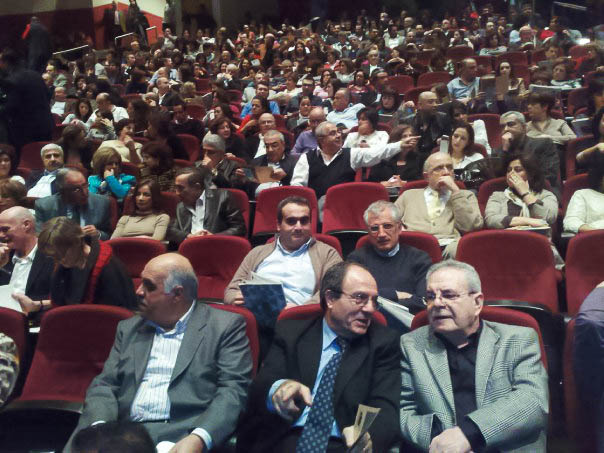
During the month of February 2010, the Foundation conducted a publicity campaign to make its goals and activities known to the Lebanese public, and the campaign was taken up by the press. To close it, the Foundation organised an evening dedicated to ṭarab at the Pierre Abou Khater Auditorium of Saint Joseph University in Beirut, with the Moroccan singer Fouad Zabadi and the Asil Ensemble, led by the artist Mustafa Said, then the Foundation’s director.
The poster announced it as AMAR’s first concert. Four days after the Foundation had presented itself to the press, and six months after its founding conference, the music it had set out to preserve and share went on stage before a Beirut audience.

- Date
- Saturday 20 February 2010, 8:30 pm
- Venue
- Pierre Abou Khater Auditorium, Saint Joseph University, Damascus Road, Beirut
- Voice
- Fouad Zabadi
- Ensemble
- Asil Ensemble, led by Mustafa Said
- Organiser
- AMAR, closing its launch campaign
- Tickets
- LBP 30,000, 45,000 and 75,000, at Virgin
days after AMAR first presented itself to the press in Beirut.
- 1stconcert presented by AMAR, six months after its founding
- 5,000discs in the collection presented to the press in February 2010
- 6,000magnetic tapes in the same collection
- 3years of digitisation announced at the launch
The evening
A sahrat ṭarab for the Foundation’s first concert: a Moroccan voice of the great Egyptian repertoire, with the Asil Ensemble.
20 Saturday February 2010
20:30 Beirut
In Arabic, the poster billed Fouad Zabadi as sayyid al-ghināʾ, master of song; in English, as “the great tarab singer”. A few days before the concert, Kamal Kassar told the magazine Laha that the singer excelled in the finest works of the great names, from Muhammad Abd al-Muttalib to Karem Mahmoud and Wadih al-Safi.
Beside him played the Asil Ensemble, which Mustafa Said had founded in 2003 to write new music from within the classical Arab tradition. Said, then AMAR’s director, led the ensemble on stage.
In its announcement, As-Safir presented the evening as the first of the Foundation’s artistic activities. It closed a month in which AMAR had introduced itself to the Lebanese public.


The launch
In February 2010 AMAR presented itself to Beirut: a press conference, interviews and announcements, then the concert.
16 Tuesday February 2010
12:00 Beirut
Who is AMAR, when was it born, and what does it want? Kamal Kassar answered at the Press Syndicate. The Foundation had been created in August 2009, in his home, and had quickly gathered people who shared his love of traditional Arab music. Its collection then held some 5,000 discs and 6,000 magnetic tapes, most of it from the Anani collection, which Kassar had completed in Damascus, Aleppo and other Arab cities.
The programme he set out had four parts: to preserve the recorded and written heritage of Arab music with the latest technology, to support research and scientific documentation, to transmit the tradition, and to publish it on CDs, in print and online. Digitising the collection would take three years; a website and an internet radio were to follow. Behind the work stood the Consulting & Planning Board formed at the founding conference, with Jean Lambert, Virginia Danielson, Frédéric Lagrange and Nidaa Abou Mrad among its members.
Kassar also explained the choice of voices. There was little point in republishing Umm Kulthum or Abd al-Wahhab, whom everyone knows by heart; AMAR would bring back the great artists who had been forgotten or eclipsed, such as Fathiyya Ahmad, Salih Abd al-Hayy, Nadra Amin, Marie Jubran and Muhammad al-Qubbanji.
“If we held these buried treasures without sharing them with others, our role would have no value and our memory would be mutilated.”
Kamal Kassar, in L’Orient-Le Jour, 20 February 2010
Listen
AMAR published the evening on CD. Seven excerpts, two minutes each.
The CD
An Evening of Tarab in Beirut with Fouad Zabadi
Fouad Zabadi and the Asil Ensemble, led by Mustafa Said, at the Pierre Abou Khater Auditorium.
Hear the early recordings of the Arab world in Rawdat al-Balabel, AMAR’s podcast on the music of its archive.
Listen to the podcastTimeline
From the founding conference to the first concert, and the Asil Ensemble’s later stages with AMAR.
- Qornet el HamraThe founding conferenceResearchers set AMAR’s strategy and form its Consulting & Planning Board. The conference
- BeirutKamal Kassar in LahaAn interview on the Foundation’s goals, days before its launch, announcing a concert by Fouad Zabadi.
- BeirutPress conferenceAMAR announces the start of its activities at the Press Syndicate.
- BeirutAn Evening of TarabFouad Zabadi and the Asil Ensemble, led by Mustafa Said, at the Pierre Abou Khater Auditorium.
- LebanonA Hundred Years of RecordingsAn international conference with the Antonine University, closing with a concert. The conference
- Abu DhabiAsil at the Abu Dhabi FestivalThe ensemble opens the festival’s main music programme, presented with AMAR. The concert
- LondonAsil at the BarbicanWith Karima Skalli, the ensemble opens Shubbak’s music programme with three Burdas, presented with AMAR. Burda at the Barbican
- BerlinAsil in BerlinThe ensemble plays Autism during AMAR’s exhibition at the Humboldt-Box. Against Oblivion
- BeirutThe first AMAR BiennaleSongs of Satire at the Sursock Museum: talks, films, a residency and a closing concert. Biennale 2025
People & partners
The voice and the musicians on stage, and the people who presented AMAR to Beirut.
Fouad Zabadi
Born in Meknes in 1955, the Moroccan singer is known across the Arab world for qaṣīdas, muwashshaḥāt and the classic songs of Egypt, above all those of Muhammad Abd al-Muttalib. In 2024 the Arab Music Festival in Cairo honoured him at its 32nd edition.
His CD with AMARMustafa Said
Born in Cairo in 1983, the ʿūd player, singer and musicologist founded the Asil Ensemble for contemporary classical Arab music in 2003. He was AMAR’s director at the time of the concert, and was one of the voices of its podcast, Rawdat al-Balabel.
Rawdat al-BalabelAsil Ensemble
Based in Beirut, the ensemble writes new music within the classical Arab tradition. It had recorded Rubāʿiyyāt al-Khayyām (2008) and Asil (2009) before this first concert with AMAR, and later played for AMAR in Abu Dhabi and Berlin.
Asil in Abu Dhabi, 2014Kamal Kassar
Founder and President of AMAR. A lawyer with a lifelong passion for music, he acquired the Anani collection of Arab music in 2009 and created the Foundation to preserve it and share it. He presented AMAR to the press on 16 February 2010.
About AMARNidaa Abou Mrad
Musicologist, violinist and composer at the Antonine University, and a member of the board of specialists formed at AMAR’s founding conference. He launched the Foundation’s programme with Kamal Kassar at the press conference.
The boardSaint Joseph UniversityThe Pierre Abou Khater Auditorium, Damascus Road, Beirut
Press SyndicateHost of AMAR’s press conference, 16 February 2010
AMAROrganiser of the evening, the Foundation’s first concert
Press and sources
How the Lebanese press announced the Foundation and its first concert, in Arabic and French.
«إحدى اكبر المجموعات من التسجيلات الموسيقية العربية»
“one of the largest collections of Arab music recordings”
« une sorte de gardiens de la mémoire musicale »
“guardians, of a kind, of musical memory”
«أوّل مسعى حقيقي لصيانة التراث الموسيقي العربي»
“the first real effort to safeguard the Arab musical heritage”
- مؤسسة موسيقية جديدةAs-Safir, 16 February 2010, issue 11519 (Arabic)
- Amar se penche sur la musique traditionnelle arabeC. K., L’Orient-Le Jour, 20 February 2010 (French)
- كمال قصّار رئيس مؤسسة التوثيق والبحث في الموسيقى العربيةLaha, 15 February 2010 (Arabic)
- An Evening of Tarab in Beirut with Fouad ZabadiAMAR, CD and excerpts
- The founding conference, 17–19 August 2009AMAR, the conference that formed its Consulting & Planning Board
Photographs: AMAR archive.
What came next
From a first concert to the archive
At the launch, Kamal Kassar announced the digitisation of the collection, a website and an internet radio. Since then AMAR has published restored recordings on CD, opened its archive to listeners through the podcast Rawdat al-Balabel, and returned to the stage with the Asil Ensemble in Abu Dhabi and Berlin.